By Archie Cole September 15, 2026
For a large ticket interchange furniture store strategy to work, the transaction amount is only the beginning. A $3,000, $8,000, or $15,000 furniture sale does not automatically receive a special interchange rate simply because the ticket is large.
The network, card product, merchant category, acceptance channel, transaction data, authorization and settlement behavior, and the specific interchange program all affect qualification.
That distinction matters in furniture retail because percentage-based card costs become conspicuous when the selling price is measured in thousands rather than hundreds of dollars. A few tenths of a percentage point may barely register on a throw pillow; applied to a sectional, commercial furnishing package, or designer order, the dollar difference becomes meaningful.
Furniture retailers with a substantial mix of interior designers, builders, hospitality companies, property managers, offices, developers, and other business buyers may have a particularly interesting opportunity.
Some business, corporate, purchasing, and other commercial card products can participate in commercial interchange programs that ordinary consumer credit and debit cards cannot.
Current Visa and Mastercard schedules illustrate this clearly, but they also show why there is no universal “$3,000 large-ticket rate.” Visa and Mastercard use different program structures and thresholds.
The practical job is therefore not to ask, “Do we process large transactions?” It is to determine which of those transactions are technically eligible, whether the required data reaches the network, and whether the resulting interchange category on the statement proves that qualification actually occurred.
Large Ticket Interchange Furniture Store: Why Big Tickets Magnify Percentage Costs
Most furniture retailers already understand that a percentage fee costs more when the sale is larger. What is easy to underestimate is how quickly relatively small pricing differences turn into material dollars.
Consider purely illustrative differences of 0.20%, 0.40%, and 0.75%. These are not current Visa or Mastercard rates. They are simply arithmetic examples showing how percentage differences scale.
| Transaction Amount | Example Rate Difference | Dollar Impact |
| $3,000 | 0.20% | $6.00 |
| $3,000 | 0.40% | $12.00 |
| $5,000 | 0.40% | $20.00 |
| $8,000 | 0.40% | $32.00 |
| $8,000 | 0.75% | $60.00 |
| $15,000 | 0.40% | $60.00 |
| $15,000 | 0.75% | $112.50 |
That is why interchange on high ticket retail deserves transaction-level attention. Saving 40 basis points on fifty genuinely qualifying $8,000 transactions would represent substantially more dollars than improving dozens of low-ticket accessory transactions by the same number of basis points.
A large ticket interchange furniture store analysis should still resist the temptation to multiply an attractive difference by every large sale. Some sales will be consumer cards. Some will be debit. Some commercial cards will fall into different programs. Some transactions will miss enhanced-data or other qualification requirements.
The meaningful metric is qualified volume, not merely high-dollar volume.
Four costs that should not be mixed together
When management discusses furniture store processing costs, four different cost layers often get collapsed into one “rate”:
- Interchange is the network-defined transfer fee associated with the transaction’s interchange category. Visa itself distinguishes interchange reimbursement fees from the broader merchant discount paid by a merchant to its financial institution.
- Network assessments and other card-brand fees are separate network charges.
- Processor markup is the processor or acquiring provider’s own pricing component.
- Gateway, software, device, and ancillary fees can add another layer.
Large-ticket qualification primarily concerns the interchange category. It does not magically eliminate the processor’s margin or other network and technology charges.
A processor therefore should not present a lower overall quote as proof of large-ticket interchange savings unless it can identify which interchange category changed.
How Large-Ticket Interchange Categories Work
Networks publish commercial interchange structures that differ materially from ordinary consumer pricing.
Visa’s current U.S. schedule, effective April 18, 2026, publishes separate commercial categories for Corporate and Purchasing products, including Commercial Product 3, Commercial Card Present, Commercial Card Not Present, Non-Qualified, and Commercial Product Large Ticket.
The same Visa U.S. interchange reimbursement fee schedule also publishes distinct Straight Through Processing and Large Purchase Advantage structures, demonstrating why a merchant must identify the applicable program rather than assume that one transaction threshold applies to every high-dollar Visa sale.
Mastercard’s currently published U.S. commercial schedule takes a different approach. Its Commercial Payments Account table states that amounts below $10,000 receive commercial rates, while Large Ticket 1 covers $10,000 through $25,000 at 1.20%, followed by additional tiers at higher transaction values.
Its Large Market Credit table separately lists Data Rate I, II, III, Large Ticket, Standard, and other commercial categories.
Those tables immediately expose a flaw in many large ticket interchange furniture store sales pitches: there is no single network-wide threshold called “the furniture large-ticket threshold.”
For example, Mastercard’s currently published Commercial Payments Account Large Ticket 1 begins at $10,000. Visa separately publishes STP tiers beginning below and above $7,000 and a Large Purchase Advantage schedule whose card-not-present large-purchase tiers begin above $10,000. Those are different programs, not interchangeable definitions of “large ticket.”
Large Ticket Program Qualification Requirements
Large ticket program qualification can depend on several variables simultaneously:
Card network. Visa and Mastercard do not use identical commercial interchange structures.
Card product. A personal rewards card, consumer debit card, small-business card, corporate card, purchasing card, commercial prepaid product, and commercial payment account should not be treated as equivalent.
Transaction amount. Dollar bands can matter, but the applicable bands depend on the particular program.
Merchant classification. The merchant category code and the network/acquirer configuration help establish what type of transaction is being submitted.
Entry environment. A chip transaction at a showroom terminal is not automatically equivalent to a manually keyed transaction, payment link, ecommerce order, stored credential, or virtual-terminal sale.
Transaction data. Enhanced commercial data may be relevant to certain commercial categories.
Authorization and clearing behavior. The transaction has to be processed using the flow appropriate to that transaction type and program.
Settlement and presentment. Merchants should use the processor-supported workflow and avoid unnecessary delayed presentment. Visa advises merchants to submit transactions promptly and warns that delays can increase late-presentment dispute risk.
Processor or gateway implementation. Even an eligible card cannot benefit from fields that the merchant’s gateway never sends.
Mastercard likewise states that interchange qualification can depend on factors such as merchant category, the time between authorization and clearing, transaction data, and enhanced-data submission.
Its U.S. merchant interchange guidance also emphasizes that every requirement associated with a particular interchange rate must be satisfied for the transaction to qualify.
Card type changes the opportunity
| Card Type | Typical Large-Ticket Relevance | Enhanced Data Opportunity | Key Limitation |
| Consumer credit | Usually follows consumer interchange rather than commercial large-ticket structures | Limited commercial enhanced-data relevance | High dollar value does not turn a consumer card into a commercial card |
| Consumer debit | Separate debit economics and regulation may apply | Not commercial Level 2 merely because the sale is large | Do not compare directly with commercial credit |
| Business card | May participate in commercial pricing depending on product/program | Level 2 or other commercial data may matter | Eligibility varies by network and product |
| Corporate card | Strong B2B use case | Enhanced data can be relevant | Still must meet the applicable transaction criteria |
| Purchasing card | Designed for procurement use | Enhanced transaction data is particularly relevant | Program, data, amount, and acceptance conditions still govern |
The table is intentionally conditional. “Business card” is not another way of saying “automatically qualified.”
Level 2 Data for Big-Ticket Furniture Sales
The phrase level 2 data big ticket sales often gets used as though Level 2 were a coupon code: enter tax and a PO number, and the rate drops.
That is not how interchange qualification works.
Level 2 processing commonly carries additional commercial transaction information such as sales-tax and customer-reference data, but support is not uniform across every card and processor.
Cybersource’s first-party Level II data documentation specifically notes that Level II support is processor- and card-specific and describes sales-tax and unique customer-code information as core Level II data.
For a furniture retailer, the operational lesson is more important than the glossary definition: the data must be mapped into the transaction’s actual enhanced-data elements and submitted through the processing chain.
Typing “PO 19344 – Dawson Design” into a free-form POS note does not establish that the processor transmitted a customer-reference element to the network.
That distinction is central to level 2 data big ticket sales.
Typical data sources in a furniture order
| Field | Store Source | Why It Matters | Common Error |
| Sales tax amount | POS/order tax engine | Commercial data programs can use actual tax information | Sending a made-up tax value |
| Customer reference/code | Trade account or buyer record | Helps identify the commercial transaction | Saving it only as an internal note |
| PO/project reference | Designer, builder, hotel, office buyer | Useful for procurement reconciliation and supported enhanced fields | Mapping it to the wrong gateway field |
| Order/reference number | Furniture order system | Connects payment and commercial order data | Losing it when moving from POS to gateway |
| Transaction total | Invoice/order | Must correspond to the actual charge | Combining separate transactions for analysis |
A tax-exempt designer or business customer deserves particular care. The tax field should reflect the actual tax treatment of the transaction under the network and processor’s supported format. The store should never fabricate a tax amount simply to populate an enhanced-data field.
A practical Level 2 capture workflow
For an eligible commercial transaction, the store’s workflow should look something like this:
Commercial card detected
→ actual sales tax calculated
→ legitimate customer/PO reference captured
→ supported enhanced fields populated
→ transaction authorized
→ required data transmitted through the gateway/processor
→ transaction cleared and settled appropriately
→ resulting interchange category reviewed
That last step is frequently missing.
A large ticket interchange furniture store cannot determine whether its enhanced-data project works merely by confirming that the POS displays a PO-number box. It needs evidence downstream.
Level 2 is not Level 3
Level 2 generally deals with transaction-level commercial data such as tax and customer-reference information. Level 3/Product 3 can involve more detailed line-item information.
A furniture retailer selling ten desks to an architecture firm may possess excellent SKU, unit-price, quantity, and tax information, but possessing it in the inventory system is different from submitting it as Level 3 transaction data.
This article focuses on Level 2 and large-ticket mechanics rather than turning the discussion into a Level 3 implementation guide.
Worked Example: An $8,000 Sectional Under Standard vs Large-Ticket Pricing
An $8,000 example needs special care because current network documentation does not support a blanket statement that every $8,000 transaction is eligible for a program called “large ticket.”
In Mastercard’s current Commercial Payments Account schedule, the published Large Ticket 1 band begins at $10,000. Visa’s 2026 schedule, meanwhile, publishes a $7,000–$14,999.99 STP Tier 2 and separately publishes Commercial Product Large Ticket and other programs.
These are network- and program-specific categories with additional qualification conditions; an $8,000 furniture sale cannot simply be assigned to one based on amount alone.
For that reason, the following large ticket interchange furniture store example uses deliberately hypothetical pricing.
These numbers are illustrative and are not current network rates.
Assume, only for teaching the calculation:
- nonoptimized interchange example: 2.50% + $0.10
- hypothetical qualified large-ticket example: 1.50% + $30.00
| Scenario | Interchange Formula | Dollar Cost | Difference |
| Illustrative standard/nonoptimized | $8,000 × 2.50% + $0.10 | $200.10 | — |
| Illustrative qualifying large-ticket | $8,000 × 1.50% + $30.00 | $150.00 | $50.10 lower |
The math is:
Standard example
$8,000 × 0.025 = $200
$200 + $0.10 = $200.10
Qualified example
$8,000 × 0.015 = $120
$120 + $30 = $150.00
Illustrative per-sale difference: $50.10
If ten otherwise identical transactions genuinely qualified, the illustrative difference would be $501. At fifty, $2,505. At one hundred, $5,010.
That multiplication is mathematically correct but should not become a forecast unless the store can establish that those transactions really are eligible.
The proper formulas are:
Per-sale savings = standard interchange cost − qualified large-ticket interchange cost
and:
Annualized savings = qualifying transaction count × average per-sale savings
Notice the word qualifying. If only 8% of a store’s large orders use technically eligible commercial card products, a calculation based on 100% of $3,000+ volume will wildly overstate the opportunity.
Which Furniture Transactions Do Not Qualify?
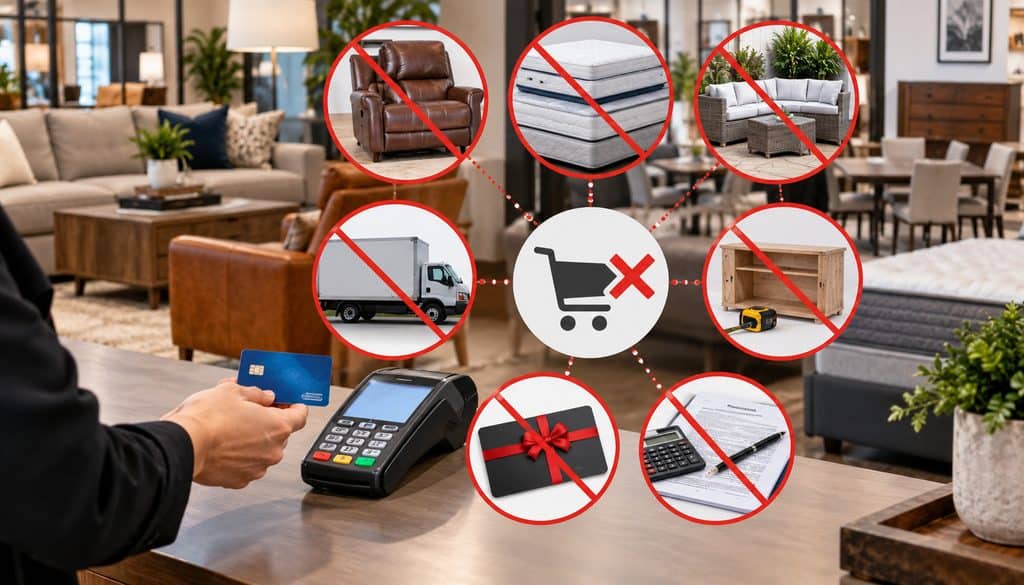
The most useful question is often not “What qualifies?” but “Why did this transaction fail to reach the category we expected?”
A large ticket interchange furniture store can have two $12,000 orders on the same day that behave very differently. One might be a properly processed corporate procurement purchase. The other might be a consumer premium card used by a homeowner. The price does not make the two payment products equivalent.
Potential nonqualification causes include the following, although the exact rule depends on the relevant network and interchange program:
| Issue | Why Qualification May Fail | Better Approach |
| Consumer card used | Commercial category may not apply | Identify addressable commercial-card volume first |
| Consumer debit used | Debit follows separate economics | Analyze debit separately |
| Unsupported commercial product | Not every business-branded card maps to every program | Confirm eligible network/card products |
| Transaction outside program amount band | Threshold is category-specific | Use current network documentation |
| Wrong or unexpected MCC | Merchant classification can affect eligibility | Verify the acquiring setup |
| Required data missing | Enhanced qualification cannot use data that was not submitted | Map gateway fields correctly |
| Incorrect/incomplete data | Field may fail validation or category rules | Validate actual transmitted values |
| Ineligible entry environment | Card-present and CNP categories may differ | Test each sales channel separately |
| Clearing/presentment issue | Processing behavior may alter qualification | Follow supported settlement workflow |
| Gateway cannot send required fields | POS collection alone is insufficient | Confirm end-to-end support |
Why Entry Method and Settlement Timing Matter
A major error in interchange on high ticket retail is treating “card transaction” as one uniform thing.
It is not.
Card-present showroom transaction
When the customer is standing at the counter and inserts an EMV card or uses contactless acceptance, the transaction can carry a card-present acceptance profile.
Current Visa documentation, for example, separately lists Commercial Card Present and Commercial Card Not Present rates.
That does not mean EMV itself guarantees the cheapest category. It means the acceptance environment is one of the facts that can affect routing and qualification.
For showroom transactions, EMV, contactless, and integrated payment technology should be treated as part of the checkout architecture rather than as interchangeable terminal features. How the customer presents the card can affect the transaction data and acceptance environment that ultimately reaches the processor.
Keyed transaction
A salesperson might take a card number by phone for a designer account, key a card because the chip will not read, or enter payment through a back-office terminal.
These are not necessarily treated like a successful chip-read transaction.
The safest operating assumption is not “keyed qualifies” or “keyed never qualifies.” It is: ask which specific commercial categories your processor says are available for that transaction environment and verify the resulting category afterward.
Ecommerce furniture order
An ecommerce furniture purchase is card-not-present. It therefore belongs in a different qualification analysis from an EMV showroom sale.
This matters for stores selling the same bedroom set both online and from a physical showroom. Product, price, and merchant are identical; payment environment is not.
Virtual-terminal trade order
Interior designers, hotels, builders, and offices may email or call orders rather than physically visiting the showroom.
Virtual-terminal acceptance is operationally convenient, but the store should confirm separately whether the gateway sends Level 2 data, what commercial products are supported, and which CNP interchange categories apply.
That is especially important for commercial card furniture orders because the business buyer may provide an excellent PO number while the payment platform fails to transmit it anywhere useful.
Deposit plus final balance
Furniture routinely involves an order deposit followed by a later balance payment.
For interchange purposes, each card charge is a transaction. If a customer places a legitimate $4,000 deposit and later pays a $6,000 balance on a $10,000 order, there are two card transactions—not one $10,000 card transaction.
That can matter because transaction-value thresholds are evaluated according to the applicable program’s transaction rules.
Payment structure should follow the real commercial agreement. Stores should not divide or recombine transactions artificially merely to chase an interchange threshold.
Custom furniture orders that use recurring or staged payment arrangements require the retailer to distinguish each legitimate payment event from the original order total. A deposit, scheduled installment, and final balance can each create a separate card transaction with its own authorization, entry method, and interchange outcome.
Delayed delivery and special orders
Furniture introduces a complication that many ordinary retailers barely face: merchandise may be ordered today but delivered weeks or months later.
This distinction becomes especially important when custom-order payments are collected over multiple stages, because an order-level balance and an individual card transaction are not the same thing for authorization, settlement, or interchange analysis.
Visa’s current rules state, for example, that for goods being shipped, except in an advance-payment situation, the transaction date generally must be on or after the shipment date. Visa also publishes separate rules for transaction processing and clearing.
That is why a furniture retailer should not try to keep an ordinary authorization open for weeks based on a rule of thumb. Use the processor-supported workflow appropriate to deposits, advance payments, delayed shipment, or final payment.
Return, cancellation, delivery, and special-order policies remain separate from interchange qualification. When fulfillment occurs weeks after payment, maintaining clear order records, delivery evidence, customer communications, and a defined chargeback and payment-dispute process for furniture sales can reduce confusion if the customer later disputes whether merchandise was delivered as agreed.
Multiple cards on one furniture sale
A customer may legitimately pay a $14,000 order with:
- $8,000 on a company card and $6,000 personally;
- two different corporate cards;
- a card plus check;
- or another valid combination.
The order total may be $14,000, but interchange is associated with the individual card transactions.
Do not assume the network sees one combined $14,000 card transaction when two $7,000 charges were submitted.
Commercial Card Furniture Orders: Designers, Trade Accounts, and B2B Buyers

Commercial card furniture orders are where the furniture vertical becomes more interesting than a generic retail interchange discussion.
Furniture stores can sell to:
- interior designers furnishing client properties;
- home-staging companies;
- hotel and hospitality operators;
- apartment and property managers;
- office operators;
- builders and developers;
- architecture firms;
- restaurants and venues;
- corporate purchasing departments.
These buyers may be more likely than a typical homeowner to use a business, corporate, purchasing, or other commercial card.
That changes the potential card mix for a large ticket interchange furniture store even when consumer shoppers remain the majority of customers.
Designer and trade accounts
Suppose a store’s ordinary retail buyers overwhelmingly use consumer cards, but 25% of revenue comes through designer accounts. Those designer accounts could represent a disproportionate share of commercial cards and high-dollar orders.
That does not guarantee lower interchange. It creates a larger pool of transactions worth examining for commercial qualification.
A useful trade-account profile can capture:
- business name;
- internal customer number;
- legitimate PO/project reference;
- applicable tax status;
- invoice/order number;
- purchasing contact;
- payment channel.
The payment system—not sales staff—should determine card characteristics through appropriate card-product identification mechanisms. Staff should not guess whether a card is a purchasing card because it carries a company logo.
For commercial card furniture orders, order data and payment data need to meet in the actual gateway transaction.
Tax-exempt buyers
A hotel operator, designer, reseller, government buyer, or another organization may sometimes present valid tax-exempt purchasing circumstances.
Whatever the reason, the Level 2 tax value should represent the actual transaction.
“Level 2 wants tax” is not a justification for inventing tax.
Commercial-card acceptance workflow
A sound B2B workflow looks like this:
- Identify the trade or business customer.
- Confirm the invoice and actual charge amount.
- Capture a legitimate PO, project, or customer reference.
- Calculate the actual applicable tax.
- Accept payment through the correct sales channel.
- Allow the gateway/processor to identify the card product.
- Submit supported commercial data.
- Clear and settle using the supported transaction flow.
- Review the interchange category.
- Investigate mapping or qualification when the expected category is not achieved.
For consumer high-ticket purchases, furniture financing at checkout should be evaluated separately from card interchange optimization. Financing changes how the purchase is funded, while large-ticket interchange concerns the economics and qualification of an eligible card transaction.
How to Audit Large-Ticket Qualification on Your Processing Statement
A store cannot manage furniture store processing costs effectively from a single blended percentage alone.
The familiar formula is:
Effective processing rate = total processing cost ÷ total card volume
If $50,000 of fees accompanied $2 million in card volume, the effective rate would be 2.50%.
That is useful for trend monitoring, but it does not tell management whether a $12,000 corporate furniture order qualified correctly.
Build a transaction-level audit
For a large ticket interchange furniture store, a useful audit sheet looks like this:
| Transaction | Amount | Card Type | Entry Mode | Data Level | Interchange Category | Qualified? |
| Order 1 | ||||||
| Order 2 | ||||||
| Order 3 | ||||||
| Order 4 |
Populate it from actual processor detail.
Depending on the provider, a merchant statement may show a recognizable interchange description, abbreviated category, qualification bucket, or only partial information. If the statement is insufficient, request transaction-level interchange detail from the processor.
Why one effective rate can hide a problem
Imagine a furniture store with many low-cost debit transactions, a healthy mix of ordinary consumer sales, and a smaller but valuable set of corporate furnishing orders.
The total effective rate may look acceptable.
Meanwhile, every large corporate transaction could be falling into an unintended commercial category because the gateway’s tax field is empty.
The cheap debit volume masks the commercial-card problem.
That is why a large ticket program qualification needs its own KPI.
Possible metrics include:
- eligible commercial transaction count;
- eligible commercial volume;
- successfully qualified count;
- successful qualification rate;
- average interchange cost on qualifying transactions;
- downgrade/fallback count;
- commercial volume by entry channel.
What is an interchange downgrade?
In operational terms, a downgrade means the transaction did not reach the interchange category the merchant expected and instead cleared under another applicable category.
The cause may be data, product type, acceptance environment, timing, merchant configuration, or another program condition.
Avoid diagnosing a downgrade from the category name alone. Ask the processor to trace:
Transaction did not receive expected rate
→ verify card product
→ verify amount/program threshold
→ verify MCC
→ verify entry mode
→ verify tax/customer-reference data
→ verify gateway transmission
→ verify clearing/settlement behavior
→ confirm final network interchange category
Pricing model affects visibility
Interchange-plus pricing. The network interchange component and processor markup are typically easier to distinguish. That can make qualification effects easier to audit. It does not mean interchange-plus is automatically cheapest for every merchant.
Flat-rate pricing. The provider may charge the merchant the same bundled percentage even if the provider’s underlying interchange cost changes. The merchant therefore may not receive the full economic benefit of improved qualification.
Tiered pricing. Interchange movement can be difficult to see when many network categories are grouped into processor-defined tiers. Transaction-level detail becomes particularly important.
This distinction should be part of every furniture store processing costs review.
What to Ask a Processor Before Enrolling in a Large-Ticket Program
Before changing a gateway, configuring Level 2, or accepting a savings projection, ask the processor to define the exact network mechanics.
A large ticket interchange furniture store conversation should produce specific answers to these questions:
- Which current Visa commercial or large-ticket categories can our MCC potentially qualify for?
- Which current Mastercard categories apply to our merchant setup?
- What dollar thresholds currently apply to each relevant program?
- Which business, corporate, purchasing, commercial prepaid, or other commercial products are eligible?
- Is Level 2 required for the category being proposed?
- Which exact enhanced-data fields must our transaction carry?
- Does our existing POS or gateway populate and transmit those fields?
- Which entry environments are supported?
- How are keyed, virtual-terminal, ecommerce, payment-link, and other CNP transactions treated?
- What clearing or settlement requirements apply?
- How are legitimate deposits and final balances evaluated?
- Is processor/acquirer configuration or program enrollment required?
- What category or code will a successfully qualified transaction show on the statement?
- Which category is typically seen when a transaction fails the targeted qualification?
- Does the projected saving represent interchange only, or does it also assume a change in processor markup?
- Can you model results using three to six months of our actual card and transaction mix?
| Question | Why It Matters | Weak Answer to Watch For |
| Which network category? | Confirms there is an identifiable program | “You’ll just get a lower rate” |
| Which cards qualify? | Defines addressable volume | “All big sales” |
| Which fields are required? | Exposes data requirements | “The system handles it” |
| Which entry modes qualify? | Separates showroom and CNP behavior | No distinction between channels |
| What threshold applies? | Prevents “$3,000+” generalizations | One threshold stated for every network |
| How will it show on statements? | Makes savings auditable | No transaction-level evidence |
| Does quote include processor markup? | Separates two cost components | “It’s all the same processing rate” |
Ask for card-mix analysis first
Before investing in configuration work, analyze:
- consumer credit;
- consumer debit;
- small-business cards;
- corporate cards;
- purchasing cards;
- other commercial products;
- card-present volume;
- keyed volume;
- ecommerce/CNP volume;
- average ticket;
- median ticket;
- distribution of transaction values.
A store with 5% eligible commercial-card volume has a different opportunity from a store where hotel, designer, developer, and office accounts create 40% commercial-card volume.
The large ticket interchange furniture store business case should reflect that difference.
Common Furniture Large-Ticket Processing Mistakes
The worst large-ticket mistakes are usually operational rather than mathematical.
| Mistake | Cost Impact | Better Approach |
| Assuming every large sale qualifies | Inflated savings forecast | Segment by network and card product |
| Treating consumer and commercial cards alike | Wrong eligibility assumptions | Analyze card type separately |
| Collecting Level 2 data but not transmitting it | Expected enhanced category may not be reached | Validate gateway mapping |
| Ignoring entry method | Showroom and CNP results get mixed | Audit channels separately |
| Ignoring clearing/settlement behavior | Qualification or dispute issues may arise | Follow processor-supported timing |
| Forecasting from one transaction | Distorted ROI | Use 3–6 months of volume |
| Calling processor markup “interchange” | Misstates savings source | Separate fee components |
| Artificially splitting sales | Creates a distorted transaction structure | Charge according to legitimate payment terms |
| Never reviewing the final category | Configuration errors persist | Audit transaction detail |
| Configuring only one location | Multi-store results become inconsistent | Standardize all locations and gateways |
Multi-location stores need configuration consistency
A furniture chain can correctly map tax and commercial reference fields at one showroom while another location still runs an outdated terminal integration.
That produces an odd pattern: same buyers, same products, same processor, different qualification performance.
Create a location-by-location inventory of:
- merchant IDs;
- MCC;
- terminal/POS software version;
- gateway;
- enabled commercial fields;
- ecommerce stack;
- virtual terminal;
- batch process.
Ecommerce and showroom volume should be measured separately
Do not calculate one commercial qualification rate for every channel unless the underlying treatment is actually comparable.
A corporate customer using an EMV card in the showroom may create a different network path from the same company’s buyer paying an emailed invoice remotely.
Card-on-file designer accounts
A designer might present a commercial card once in person and then authorize future purchases against stored credentials.
Do not assume the original transaction’s entry status or category automatically carries to later charges.
Stored-credential transactions have their own processing indicators and acceptance requirements. Confirm the exact supported flow with the processor.
Payment links and emailed invoices
The same principle applies when a trade customer clicks an invoice link.
The invoicing product needs commercial-data capability in the payment transaction itself. It is irrelevant that the accounting invoice contains a PO field if the payment gateway never includes that information in supported enhanced-data elements.
A retailer may offer different payment options for high-ticket furniture purchases such as cards, financing, or installment-based alternatives, but those options should not be confused with interchange qualification. Large-ticket interchange applies only to the qualifying card transaction being submitted through the card network.
Large-Ticket Qualification Checklist
Use this checklist before treating a projected saving as real:
- Pull three to six months of processing statements and transaction detail.
- Identify card transactions of $3,000 and above for analysis; do not assume $3,000 is a network qualification threshold.
- Separate consumer cards from commercial cards.
- Separate credit from debit.
- Separate business, corporate, purchasing, and other commercial products where data permits.
- Separate card-present from keyed, ecommerce, payment-link, stored-credential, and virtual-terminal transactions.
- Confirm the merchant category code.
- Check the current Visa commercial and large-purchase schedule.
- Check the current Mastercard commercial large-ticket schedule.
- Identify the exact program and threshold rather than using a universal “large-ticket” threshold.
- Confirm eligible card products.
- Confirm acceptance-channel requirements.
- Confirm relevant authorization, clearing, and settlement requirements.
- Verify Level 2 capability.
- Map the actual sales-tax amount.
- Map the legitimate customer, PO, or reference field.
- Confirm those values are transmitted, not merely stored in the POS.
- Determine whether acquirer or gateway configuration is required.
- Run a legitimate eligible commercial transaction.
- Obtain the resulting interchange category.
- Investigate unexpected categories.
- Track qualification rate monthly.
- Measure processor markup separately.
- Calculate actual interchange savings from real qualified transactions.
- Repeat the test at every store and ecommerce channel.
For a large ticket interchange furniture store, this checklist is more valuable than a promised headline rate because it follows the transaction from showroom order to network classification.
Practical Furniture Large-Ticket Optimization Workflow
- Pull 3–6 months of processing statements. Obtain transaction detail where possible, not only summary pages.
- Identify $3,000+ transactions. Use $3,000 as your internal analysis filter if it matches your sales profile—not as a claim about network eligibility.
- Separate consumer, debit, and commercial cards. Establish how much potentially addressable commercial volume exists.
- Separate card-present and CNP channels. Include ecommerce, keyed, virtual-terminal, invoice-link, and stored-credential volume.
- Confirm the MCC. Make sure the acquiring account describes the business accurately.
- Review current interchange categories. Do not rely on a rate sheet from several years ago.
- Verify current Visa and Mastercard requirements. Identify the exact programs relevant to the card products you accept.
- Identify technically eligible commercial-card volume. Remove obvious consumer and debit transactions from the large-ticket opportunity model where the targeted commercial program does not apply.
- Verify POS/gateway Level 2 support. Ask about actual transmission, not UI fields.
- Map the tax field. Use the true tax charged.
- Map the customer/PO reference. Connect legitimate trade-account data to the supported commercial element.
- Confirm entry-mode eligibility. Determine separately what happens with EMV, contactless, keyed, ecommerce, and virtual-terminal acceptance.
- Confirm transaction-timing requirements. Use the processor-supported flow for authorization, clearing, deposits, and delayed delivery.
- Configure or enroll where required. Whether formal enrollment is needed depends on the provider and program.
- Test a legitimate commercial transaction. Do not manufacture a transaction solely for qualification.
- Review the resulting interchange category. This is the proof point.
- Correct mapping or other downgrade causes. Work backward from the network result.
- Track qualification monthly. Monitor qualified transactions against technically eligible transactions.
- Compare processor markup separately. A successful interchange project does not justify an excessive markup.
- Calculate actual savings. Compare verified before-and-after interchange results.
- Reassess after material changes. New POS software, gateways, merchant IDs, ecommerce platforms, acquisitions, or card mix can change outcomes.
Annual savings worksheet
| Metric | Value |
| Annual card volume | |
| Volume above relevant program threshold(s) | |
| Commercial-card volume | |
| Transactions technically eligible | |
| Transactions actually qualified | |
| Qualification rate | |
| Average savings per qualified sale | |
| Estimated annual interchange savings | |
| Processor/program/technology cost | |
| Net estimated benefit |
Do not fill the blank cells with industry averages. Use actual store data.
Frequently Asked Questions
What is a large-ticket interchange for a furniture store?
For a large ticket interchange furniture store, the term generally refers to network interchange categories or commercial payment structures that can produce different economics for qualifying high-dollar transactions.
There is no single universal furniture-store rate. Current Visa and Mastercard documentation shows different commercial program structures, amount bands, card products, and rate categories.
Does every furniture sale over $3,000 qualify for large-ticket pricing?
No.
The exact phrase large ticket interchange furniture store should not be interpreted as “$3,000 equals large-ticket qualification.” A $3,000 threshold may be useful for a retailer’s internal reporting, but the applicable network program determines its own qualification conditions.
For example, Mastercard’s currently published Commercial Payments Account schedule places transactions below $10,000 under commercial rates and begins Large Ticket 1 at $10,000.
Which cards qualify for large-ticket interchange?
It depends on the network program.
Commercial products such as particular business, corporate, purchasing, large-market, or commercial payment-account products may participate in relevant commercial categories. Consumer credit cards and consumer debit cards should not be presumed eligible merely because the sale is large.
Do consumer rewards cards qualify for commercial large-ticket programs?
A consumer premium or rewards card does not become a commercial card because it is used for a $10,000 bedroom set. Consumer premium cards can be costly on high-dollar transactions, but the solution is not to relabel them as commercial transactions.
What is Level 2 data on a furniture transaction?
Level 2 data big ticket sales generally refers to enhanced commercial transaction information such as sales-tax and customer-reference information, subject to the supported network, processor, and card product. Level 2 should not be confused with Level 3 line-item data.
What customer code should a furniture store submit?
Use a legitimate customer or commercial reference appropriate to the order and the field supported by the processor. A designer’s PO number, account code, project reference, or another genuine business identifier may be appropriate depending on the implementation. Do not invent a value merely to fill the field.
Does sales-tax data affect commercial-card qualification?
It can be part of enhanced commercial transaction data for supported programs. The tax value must represent the real transaction. Tax-exempt transactions should be transmitted according to the processor/network’s applicable specification rather than populated with fictional tax.
How much can large-ticket interchange save on an $8,000 sale?
There is no universal answer.
The example in this article used hypothetical, non-network rates and produced a $50.10 difference solely to demonstrate the calculation. Actual savings depend on the card, network, applicable program, transaction environment, data, and processor pricing.
Do keyed furniture transactions qualify?
Possibly for some commercial categories, but you should not assume a keyed transaction receives the same treatment as EMV card-present acceptance. Ask the processor which category applies to the actual card product and keyed environment, then verify it in transaction detail.
Can ecommerce furniture orders qualify for large-ticket interchange?
Some commercial card-not-present programs exist, but qualification is program-specific. Visa, for example, currently publishes separate commercial card-not-present pricing and a Large Purchase Advantage table with CNP transaction bands. That does not make every ecommerce furniture sale eligible.
Do designer and trade accounts create more qualification opportunities?
Potentially.
Trade accounts often increase the share of commercial card furniture orders, including business, corporate, and purchasing-card usage. The opportunity still depends on actual cards used and whether the transaction satisfies the relevant program requirements.
What happens if required Level 2 data is missing?
An expected enhanced-data category may not be achieved, depending on the card and program. The first diagnostic step is to determine whether the data was actually transmitted—not simply whether store staff entered it.
How do I know whether a transaction qualified on my statement?
Look for transaction-level interchange information, including category name/code, card type, amount, and any qualification indicators your provider exposes. If the statement does not supply enough detail, request interchange-level transaction reporting from the processor.
Is large-ticket optimization useful under flat-rate pricing?
The provider’s underlying interchange economics may improve, but a merchant charged a fixed bundled price may not receive the same direct benefit. Review the contract and pricing structure before calculating savings.
What should I ask my processor before enrolling?
Start with the exact Visa and Mastercard category, eligible card products, transaction threshold, Level 2 or other data requirements, entry environments, clearing/settlement conditions, gateway compatibility, configuration requirements, and how the qualified category will appear in reporting. Then ask for a forecast based on your real card mix rather than a single demonstration transaction.
Conclusion
Large-ticket optimization is a qualification problem, not an amount-only discount.
Furniture retailers feel percentage differences sharply because sectionals, bedroom packages, hospitality orders, and designer purchases can easily reach several thousand dollars. But the opportunity is concentrated in transactions that actually satisfy the relevant network program.
Commercial cards can provide stronger enhanced-data opportunities than ordinary consumer cards, while debit, consumer rewards cards, ecommerce payments, keyed orders, and stored credentials may follow different paths.
Level 2 information also has to travel farther than the POS screen. Tax, customer references, and other supported commercial fields matter only when the gateway and processor transmit them correctly.
The $8,000 example illustrates why the arithmetic can be attractive, but actual savings should be measured against current network categories and real transaction data. A merchant should know what qualified, what did not, why it did not, and whether the processor’s own markup changed independently.
That transaction-level discipline is what turns large ticket program qualification from a rate-sheet promise into measurable payment optimization.