
By Archie Cole September 15, 2026
For a retailer trying to get authorization capture timing custom orders right, the first rule is not to confuse an approved card authorization with an eight- or ten-week reservation of the customer’s money. A card authorization is temporary.
When a made-to-order sectional will not be ready for months, the cleaner operational model is usually to capture a legitimate deposit when the order is accepted, document the expected production and delivery window, and obtain a fresh authorization or payment for the remaining balance when the furniture reaches the appropriate balance-due milestone.
That structure solves several problems at once. The store is not depending on an authorization that may have expired. The customer does not necessarily see the entire $8,000 purchase hit a statement ten weeks before delivery.
Finance staff can distinguish money actually collected from money merely authorized, and the delivery team has a defined process for confirming the final balance before a truck leaves the warehouse.
This does not mean every custom furniture order must use the same deposit percentage or that full advance payment is always prohibited. Contract terms, state law, processor requirements, card-network rules, manufacturer commitments, and the merchant’s actual fulfillment model all matter.
The central payment principle is more durable: do not design an eight- to twelve-week fulfillment process around the assumption that one ordinary card authorization can remain usable for the entire production cycle.
Authorization Capture Timing Custom Orders: Why the Original Auth Expires
An authorization answers a relatively narrow question: will the issuer approve this card transaction at this point in time? An approval may place an authorization hold against available credit or funds, but that approval has a defined transaction lifecycle.
Capture is different. Capture tells the payment system to move an approved transaction toward clearing and settlement. Presentment is part of that downstream process. For a normal retail sale, authorization and capture may occur so close together that showroom staff never think about the distinction.
Custom furniture exposes the distinction immediately.
Suppose a customer selects an $8,000 sectional on September 15. Fabric is special ordered, the frame will be built to specification, and the manufacturer estimates ten weeks before the piece reaches the retailer.
If the store authorizes $8,000 on September 15 but plans to capture that authorization around Thanksgiving, it has created a timing problem. Ordinary authorization validity is not designed around an arbitrary furniture production schedule.
Visa’s current rules distinguish ordinary authorization processing from later authorization activity that may be needed when fulfillment is delayed, so retailers should follow the applicable Visa authorization, reauthorization, reversal, and transaction-processing requirements rather than assuming an approval obtained when the sofa was ordered will remain usable until delivery.
The right authorization capture timing custom orders process therefore starts by separating four events:
| Stage | What Happens | Merchant Risk | Control |
| Authorization | Issuer approves a transaction and may reduce available funds | Approval can expire or cease to support later capture | Know processor/network validity rules |
| Capture | Merchant submits an authorized transaction toward settlement | Capturing too late can create qualification or processing problems | Capture within the applicable permitted period |
| Deposit | A real portion of the order price is charged and settled | Cancellation/refund terms must be clear | Treat it as its own completed transaction |
| Final balance | Remaining amount becomes payable later | Card may decline or credentials may have changed | Obtain a fresh payment authorization at the proper milestone |
A furniture deposit should therefore not be implemented as “authorize $2,000 today and leave it hanging for ten weeks.” If the $2,000 is actually due at order acceptance, it should normally be processed as the completed deposit transaction supported by the merchant’s processor configuration and disclosed terms.
How Long Card Authorizations Last on Long-Lead Orders

There is no responsible universal answer such as “all card authorizations last seven days.”
Authorization validity depends on the network, transaction classification, processor/acquirer configuration, merchant category, card-present or card-not-present environment, and whether specialized authorization frameworks apply. Some platforms expose a specific “capture before” deadline to merchants precisely because authorization windows vary.
Mastercard’s current Transaction Processing Rules, for example, distinguish ordinary authorizations from preauthorizations and contain detailed rules governing reversals, completion, clearing, and additional preauthorization messages.
Merchants should obtain the applicable operational deadline from their processor rather than building store policy around a generic internet rule of thumb.
That nuance is central to auth expiration long lead time orders. An eight-, ten-, or twelve-week sofa production period can easily sit outside the useful lifecycle of an ordinary retail authorization.
| Network / Transaction Type | Authorization Window | Important Condition | Operational Meaning |
| Visa ordinary retail transaction | Depends on the applicable Visa rules and transaction attributes | Do not assume a long custom-order lead time is covered | Obtain processor-specific timing |
| Visa delayed fulfillment requiring reauthorization | Visa supports reauthorization concepts for qualifying delayed fulfillment | A later authorization is a new authorization event, not an assumed extension | Build a fresh-auth workflow |
| Mastercard ordinary authorization | Governed by transaction type and applicable Mastercard processing rules | Reversal and completion rules differ by authorization type | Confirm processor classification |
| Specialized/extended authorization capability | May exist through particular networks, acquirers, or gateways | Eligibility and duration are product- and transaction-specific | Do not assume furniture sales qualify |
What Happens When You Capture Too Late
If a merchant waits until an authorization is no longer valid for the intended capture, several things can go wrong.
The original approval may no longer provide the transaction support the merchant expected. Processing qualification can change. The issuer may have changed the account status. A processor may reject the attempted capture or require another authorization.
Depending on the network and transaction circumstances, authorization-related assessments or late-presentment consequences may also become relevant.
That is the practical problem behind auth expiration long lead time orders: the sofa can still be perfectly real and ready for delivery while the ten-week-old payment approval is no longer operationally useful.
There is also a customer-service issue. An authorization hold is not proof that money will remain available two months later. The cardholder could use available credit elsewhere, replace the card, report it lost, receive a new account number, encounter a fraud block, close the account, or simply have less purchasing capacity when the sofa becomes ready.
A weeks-old approval should never be treated internally as guaranteed future settlement.
For authorization capture timing custom orders, the finance team should ask the processor a transaction-specific question: “For our card-present and card-not-present custom furniture transactions, when does an authorization cease to be capturable under the applicable network and processor rules?”
That answer belongs in the store’s payment procedure and POS configuration.
Why Full Capture at Order Can Increase Furniture Dispute Risk
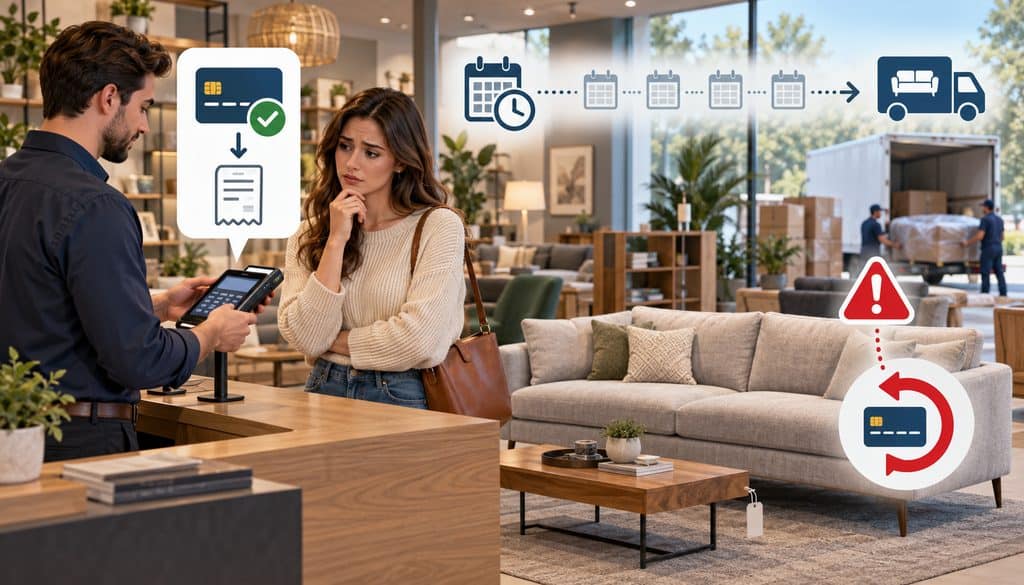
Another solution sometimes used to avoid authorization expiration is to capture the entire sale immediately.
That removes the stale-authorization problem—but creates a different risk.
Imagine an $8,000 custom sofa charged in full on September 15. The customer’s statement shows the complete $8,000 transaction, but the sofa will not arrive until late November. In October, the manufacturer advises that the fabric is backordered. Delivery slides another three weeks.
The store has had all of the customer’s money for months while performance remains incomplete.
Full advance capture is not automatically prohibited in every custom-order situation. There are legitimate advance-payment transactions, and some custom manufacturers require substantial commitment before production starts. But authorization capture timing custom orders should examine dispute exposure as well as cash flow.
Visa’s merchant dispute-prevention guidance specifically warns merchants that delayed delivery should be communicated and advises prompt transaction handling rather than casually holding transactions for later submission. It also distinguishes advance-payment scenarios from simply delaying settlement after authorization.
| Approach | Cash Flow | Authorization Issue | Dispute Exposure |
| Full authorization held until delivery | No settled funds yet | High risk of stale/expired authorization on long lead time | Customer may believe funds are tied up; final approval remains uncertain |
| Full amount captured at order | Strongest immediate cash flow | No long-delayed capture if properly processed as advance payment | Merchant carries more “paid but not delivered” exposure |
| Deposit now, balance later | Partial cash flow | Avoids relying on one authorization for months | Payment trail more closely follows fulfillment |
| Entire balance at delivery | Cash delayed until fulfillment | Fresh approval needed at end | Store bears production exposure and may face doorstep decline |
The right answer depends partly on the merchant’s manufacturing exposure. A store ordering a highly customized sectional in a rare fabric may need more commitment than a store ordering a standard sofa with only a fabric change.
But capturing everything upfront should be a conscious commercial decision, not a workaround for authorization expiration.
Chargeback Delivery Window Furniture: Why Timing Matters
The phrase chargeback delivery window furniture describes a very common operational problem: the customer remembers the payment date more clearly than the estimated manufacturing timetable.
If $8,000 left the customer’s account or appeared on a statement in September, December can feel late even when the written order said “approximately 10–14 weeks.”
Your documentation should therefore show:
- order date;
- custom or special-order designation;
- agreed specifications;
- estimated manufacturing lead time;
- expected delivery window;
- whether the delivery date is estimated or guaranteed;
- balance-due trigger;
- meaningful delay notices;
- customer acknowledgments where appropriate.
Documentation does not guarantee that a chargeback will be decided in the merchant’s favor. It gives the acquirer and issuer a coherent chronology showing what was sold, what the customer was told, what changed, and whether the merchandise was ultimately delivered.
For delayed or disputed deliveries, a documented chargeback-prevention process for furniture transactions can help staff preserve order terms, payment records, delivery evidence, refund communications, and other material needed if the cardholder later disputes the sale.
Deposit and Final Balance for Custom Furniture Orders
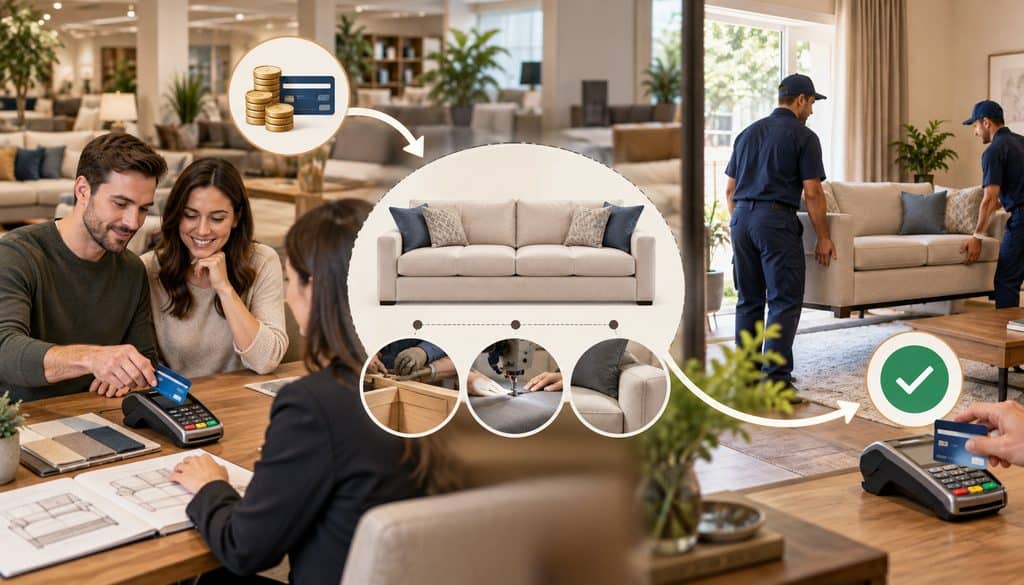
A deposit and final balance furniture structure is often the most operationally coherent way to handle a long-lead custom order because it converts one problematic ten-week payment event into two legitimate payment events tied to different stages of fulfillment.
It does not require recurring billing.
At order acceptance, the customer pays a genuine deposit. The merchant captures that payment and issues a receipt. Production begins.
During manufacturing, the store does not keep trying to preserve an authorization for the unpaid balance.
When the furniture reaches the disclosed final-payment trigger—perhaps arrival at the retailer’s warehouse, confirmation that the manufacturer has completed the piece, scheduling of delivery, or another documented milestone—the store obtains a fresh authorization or completed payment for the remaining balance.
A deposit followed by one final balance payment is different from recurring payments for custom orders, where the customer agrees to a defined series of future charges or milestone payments.
A furniture retailer should configure the POS according to the payment arrangement actually agreed with the customer rather than treating every multi-payment order as recurring billing.
A good authorization capture timing custom orders policy treats each payment according to what it really is.
The Deposit Is Its Own Transaction
Suppose the illustrative order value is $8,000 and the agreed deposit is $2,000.
The merchant charges and captures $2,000 when the order is signed. Its receipt identifies the order and the deposit. The accounting system shows:
Order total: $8,000
Deposit paid: $2,000
Balance remaining: $6,000
The store is not holding an $8,000 authorization. It is not holding a $2,000 authorization. It has received a completed $2,000 deposit payment.
How large should that deposit be? There is no universal card-network percentage.
A retailer should consider how customized the item is, what it must commit to the manufacturer, whether materials become noncancelable, expected resale value if the customer walks away, applicable state law, written cancellation terms, and processor risk expectations.
A “nonrefundable deposit” label should not be treated as self-enforcing in every jurisdiction or circumstance.
When to Capture the Final Balance Before Delivery
The balance trigger should match actual operations.
Common legitimate points include:
- merchandise arrives at the retailer’s warehouse;
- production completion is confirmed;
- delivery appointment is scheduled;
- the day before dispatch;
- customer pickup;
- delivery itself, when operationally workable.
The best choice is the one the store can state clearly at order acceptance and execute consistently.
A retailer should not tell customers “balance due at delivery” if its actual policy is to charge the stored card automatically five days before delivery. Likewise, “balance due when merchandise arrives at our warehouse” should not turn into an unexpected charge while the item is still at the manufacturer.
Capture on Delivery Furniture Store: Benefits and Risks
A capture on delivery furniture store workflow puts payment close to performance, which can reduce the psychological gap between “I paid” and “I received my sofa.”
But literal doorstep payment creates its own problem: a delivery crew can arrive with an $8,000 sectional and discover that the $6,000 balance declines.
That is expensive. The route has already been loaded. Crew time has been allocated. Another delivery may need to be scheduled, and the custom merchandise is sitting in the truck.
A better version of a capture on delivery furniture store policy is often to obtain the final approval shortly before dispatch where the merchant’s disclosed terms and processor rules permit it. The precise timing may be the morning of delivery, a day before delivery, or at another defined release point.
The goal is not to charge earlier than agreed. It is to avoid using the customer’s driveway as the first payment test.
Reauthorization and Misuse-of-Authorization Fees
Reauthorization means obtaining another authorization because the original authorization is no longer appropriate for the fulfillment timeline.
It should not be understood as “press a button that magically keeps the old approval alive.”
Visa specifically identifies reauthorization as relevant when fulfillment extends beyond the original authorization validity limit, including delayed or split e-commerce shipments. That makes the concept useful for understanding authorization capture timing custom orders, although the merchant’s actual processor must support and correctly identify the transaction.
For a furniture retailer, the more straightforward pattern is often simpler: capture the deposit at order, then initiate the final balance transaction when that balance becomes due.
Fresh Authorization Workflow
A practical sequence looks like this:
Furniture delivery-ready → final amount confirmed → customer notified → fresh authorization/payment initiated → approval received → delivery released → delivery evidence retained.
If the merchant saved the card earlier, the final transaction must still follow applicable stored-credential rules and the agreement with the customer.
Visa’s current rules require stored-credential transactions to be properly identified and tied to the applicable cardholder agreement. A saved payment token is therefore a payment capability, not unlimited permission to charge whatever amount the merchant chooses whenever it chooses.
Customer-Initiated vs Merchant-Initiated Final Payment
There are two operationally different ways to collect the $6,000 balance.
The customer can initiate it: the store sends an invoice or secure payment link, the customer opens it, enters or selects a payment method, and approves the transaction.
Or the merchant may initiate a stored-credential transaction under a prior agreement—for example, an agreement stating that the remaining balance will be charged to the tokenized card when the order reaches the defined delivery-ready milestone.
These transactions need to be correctly supported and coded by the merchant’s payment platform.
Do not save card numbers in notes, spreadsheets, CRM comments, paper order files, or unencrypted staff messages. Use a PCI-compliant token or processor-supported credential-on-file feature.
Reauthorization Is Not Incremental Authorization
Incremental authorization is a specialized network mechanism designed to add authorization amounts to an existing authorized transaction in supported circumstances.
It is familiar in industries such as lodging, car rental, and other estimated-amount environments. Furniture merchants should not assume that “incremental authorization” is simply another name for adding money to a sofa order.
For ordinary custom furniture, a deposit transaction followed by a later final payment is usually conceptually cleaner unless the acquirer or processor specifically confirms that another supported authorization model applies.
What About Partial Capture?
Partial capture also causes confusion.
A processor may allow the merchant to authorize $8,000 and capture $2,000. That does not automatically mean the remaining $6,000 authorization remains available for ten weeks or that the processor can later make another capture from the same authorization.
Platform capabilities differ.
For example, some processors explicitly explain that most manually authorized card payments allow one capture and that a partial capture may release the unused authorization rather than preserve it for another future capture.
That is why deposit and final balance furniture should generally be modeled as separate payment obligations rather than assuming “partial capture now” creates a durable future-balance facility.
Misuse of Authorization Fees and Other Consequences
The term misuse of authorization fees is frequently used loosely.
Card networks and processors can impose authorization-related assessments or other consequences when an authorization is obtained but the transaction lifecycle is not handled correctly. Exact terminology, qualification rules, and amounts can change and can differ by network, region, processor, and transaction type.
Furniture stores should therefore avoid hard-coding old fee names into operating procedures.
Ask the processor which current authorization-related assessments can appear on the merchant statement, what behavior triggers them, how unused authorizations should be reversed, and how the gateway identifies expired authorization records.
A payment administrator reviewing misuse of authorization fees should also look beyond the literal fee label. Poor authorization management can show up through downgraded qualification, settlement anomalies, declines, mismatched authorization/capture data, or increased card-not-present expense.
Authorization Reversals: Release Holds You Will Not Use
An unused authorization should not simply be ignored because “it will fall off eventually.”
If a transaction is canceled or finalized below the authorized amount, network reversal rules can require the merchant/acquirer to send the appropriate full or partial reversal within the applicable timeframe.
When an approved transaction is canceled or ultimately completed for less than the authorized amount, the applicable Mastercard authorization and reversal requirements address how full and partial reversals should be handled. That is why staff should use the processor’s reversal or void workflow instead of simply allowing unused furniture authorizations to sit open.
A basic reversal workflow is:
- Identify the open authorization.
- Determine that the authorization will not be captured as originally approved.
- Use the processor-supported full or partial reversal/void process.
- Preserve the transaction reference and status.
- Do not later attempt to capture from that stale approval.
- If money becomes due later, initiate the appropriate new transaction.
Review open authorization reports regularly. A furniture order can be canceled by the customer, rejected by the manufacturer, rewritten under a new SKU, or transferred to another payment method while an authorization remains open in the gateway.
A 10-Week Custom Sectional Payment Timeline
Consider an illustrative $8,000 made-to-order sectional.
The store and customer agree to a $2,000 order deposit. The remaining $6,000 becomes due when the completed sectional reaches the store and is ready to schedule for delivery.
| Week / Stage | Order Status | Payment Action | Amount | Evidence |
| Week 0 | Custom specifications approved | Deposit captured | $2,000 | Signed order, specifications, deposit receipt |
| Weeks 1–4 | Manufacturer production | No stale balance authorization relied on | — | Production/order status |
| Weeks 5–8 | Production continues | No payment action unless terms require one | — | Customer updates, delay notices |
| Week 9 | Sectional reaches warehouse | Final invoice/payment request | $6,000 | Ready notice, final invoice |
| Week 10 | Delivery scheduled | Fresh final payment approved/captured | $6,000 | Payment receipt |
| Week 10 | Delivered | No duplicate charge | — | Delivery ticket, timestamp, applicable photos/signature |
This timeline illustrates why auth expiration long lead time orders should be solved through transaction design rather than repeated attempts to preserve a Week 0 hold.
The production-period row matters as much as the payment rows. The store is intentionally doing nothing to the customer’s remaining balance during those weeks because nothing is yet due under the agreed structure.
Some payment platforms support an invoice structure in which the customer pays an initial deposit with the remaining balance due separately. That type of functionality is useful for custom furniture because the software can distinguish money actually collected at order from the balance that becomes payable later.
Writing Delivery Expectations That Support a Chargeback Response
Payment timing and delivery language need to agree with each other.
A store creates needless risk when the salesperson verbally promises “about six weeks,” the order form says “8–12 weeks,” the manufacturer confirms 14 weeks internally, and the customer hears nothing until Week 11.
For authorization capture timing custom orders, delivery information establishes why a charge occurred when it did and what the customer should reasonably have expected afterward.
The order confirmation should distinguish a manufacturer estimate from a guaranteed delivery date. If the supplier only gives an estimated manufacturing window, the retailer should not turn that estimate into a firm promise.
The same applies to change orders. If the customer changes fabric, configuration, size, cushion fill, leg finish, or another custom specification, document the change in price and any resulting lead-time adjustment.
Chargeback Evidence for Delayed Furniture
| Evidence | What It Supports | Limitation |
| Signed order | Customer agreed to merchandise and price | Does not prove later delivery |
| Custom specifications | Shows fabric, size, color, configuration | Must match what was actually supplied |
| Deposit receipt | Shows initial payment | Does not establish completion |
| Estimated delivery disclosure | Establishes expected timing | Weakens if later delays were hidden |
| Delay communications | Shows customer was informed | Customer acknowledgment may strengthen context |
| Final-payment notice | Shows balance trigger occurred | Does not by itself prove delivery |
| Delivery/pickup proof | Supports fulfillment | Must identify the correct order, location, and recipient |
This evidence is particularly useful when evaluating chargeback delivery window furniture cases involving a “goods not received” allegation.
A signed delivery ticket, delivery address, timestamp, recipient identity according to store procedures, carrier scan, and appropriate delivery photographs can all contribute to the evidence package.
Photographs should be used thoughtfully. Avoid collecting unnecessary images of a customer’s home or household merely because a phone camera is available.
Pickup orders require a different trail. Preserve the order-release record, pickup time, recipient information required by the store’s process, and acknowledgment that the merchandise was collected.
Goods Not Received Is Different From Damaged or Not as Described
A delivery receipt is powerful evidence against an allegation that nothing arrived, but it does not prove that the sectional was the correct color or undamaged.
A damaged-goods or “not as described” dispute may turn instead on the original specifications, signed design approval, photographs, delivery-condition records, service attempts, and the merchant’s return or repair response.
That is why the custom-order file should preserve fabric, finish, dimensions, orientation, sectional configuration, upgrades, and customer-approved change orders.
If delivery moves materially, send an updated estimate in writing. Silence is rarely an effective chargeback delivery window furniture strategy.
Handling Customer Cancellation During Production
A custom-order cancellation is not merely a card-processing decision.
The merchant may have a contract with the customer, a separate purchase obligation with the manufacturer, special materials already committed, and state-law requirements governing refunds, deposits, or consumer transactions.
Payment technology cannot determine whether the retailer is legally entitled to keep a deposit.
| Cancellation Stage | Merchant Exposure | Payment Question | Documentation Needed |
| Before production | Often lower | Should some or all of deposit be refunded? | Order terms, manufacturer status |
| During production | Higher | Is deposit retention contractually/lawfully supported? | Manufacturer commitment, custom materials, cancellation terms |
| Ready for delivery | High | Has final payment already been taken? | Completion notice, final-payment record |
| After delivery | Different dispute path | Return, damage, warranty, or description issue? | Delivery proof, return policy, product records |
Before production starts, the merchant may have little sunk cost. Depending on the contract and applicable law, a refund may therefore be easier to resolve.
After fabric has been cut or a manufacturer has accepted a noncancelable build, the retailer may have genuine economic exposure. That does not automatically make any stated “nonrefundable deposit” enforceable in every circumstance.
The store should be able to explain what the deposit reserves or pays for and how cancellation treatment changes as the order moves through production.
Cancellation After Final Balance Is Charged
Risk rises when the final balance is already paid but delivery has not happened.
Perhaps the sectional arrived at the warehouse, the store charged the agreed balance, and the customer then says the room dimensions changed and wants to cancel.
The merchant now has both a contract question and a card-dispute risk.
Follow the disclosed cancellation/refund terms, applicable law, and processor rules. If a refund is appropriate, return funds through the original payment method where practical and supported rather than improvising an unrelated reimbursement rail.
A contract claim and a card-network dispute are not the same process. A merchant may believe the customer breached the custom-order contract and still receive a chargeback from the issuer. The merchant then has to respond under the applicable card-dispute framework.
That distinction should be part of staff training.
POS and Virtual Terminal Settings for Deposit + Balance Payments
Good policy fails quickly if the POS cannot represent it.
A custom-order system should distinguish an authorization from captured money, show the amount actually paid, calculate the remaining balance, connect each payment to the same order, and maintain separate transaction references.
The minimum useful configuration looks like this:
| Feature | Why Needed | Risk if Missing |
| Order-linked deposit | Shows what was actually paid at acceptance | Deposit becomes an unexplained generic transaction |
| Remaining-balance field | Staff can see amount still due | Manual math and duplicate charges |
| Separate payment records | Deposit and balance retain individual transaction IDs | Reconciliation and refunds become difficult |
| Tokenized stored credential | Allows authorized later payment without storing raw PAN | Security/PCI exposure |
| Payment-link support | Customer can initiate remote final payment | More manual keying |
| Authorization-status report | Shows open, captured, reversed, expired states | Stale authorizations go unmanaged |
| Card-present/CNP indicator | Reflects how payment was actually taken | Fraud and pricing analysis becomes distorted |
| Refund/void history | Preserves the transaction trail | Staff cannot reconstruct cancellation handling |
| Order status | Connects payment to production and delivery | Payment can occur at the wrong milestone |
The distinction between a “deposit” field and an arbitrary partial payment matters. A generic $2,000 transaction may settle correctly but tell the staff nothing about the $6,000 still due.
Useful POS Order States
A practical custom-order workflow might use:
Deposit paid → in production → delayed/updated if applicable → delivery ready → final balance due → paid in full → out for delivery → delivered
Cancellation and refund states should be equally explicit.
This reduces the chance that a salesperson sees an $8,000 order and assumes it is paid simply because the order contains a successful card authorization somewhere in its history.
Virtual Terminal and Remote Final Payments
A virtual terminal can be useful when a customer wants to pay the final balance by phone, particularly for remote customers, designers, or trade accounts.
But keyed card-not-present transactions have different economics and fraud characteristics from an EMV transaction completed at the showroom terminal.
Where available, a secure invoice or payment link can be operationally preferable because the customer initiates the final payment without an employee manually typing card details.
High-value orders may involve different payment options for high-ticket furniture purchases, but financing, installments, deposits, and delayed card capture should remain distinct in the store’s payment records. A financing arrangement does not make an old card authorization valid for a later furniture balance.
Preventing Duplicate Capture
One of the worst custom-order mistakes is charging the same balance twice because staff confuse authorization status with settlement status.
Before processing the final balance, the POS should make the following visible:
Order total: $8,000
Deposit settled: $2,000
Balance due: $6,000
Open authorization: none
Final-balance payment: unpaid
After payment:
Order total: $8,000
Deposit settled: $2,000
Final payment settled: $6,000
Balance due: $0
For authorization capture timing custom orders, clarity at this level is not bookkeeping trivia. It prevents overcharging.
Large Final Balances and Merchant Processing Limits
Furniture naturally produces unusually large card tickets.
A store whose ordinary sale is $1,500 may occasionally close a $12,000 designer order or a $20,000 room package. If that activity differs substantially from the processing profile supplied during underwriting, legitimate transactions can attract risk review.
Do not break one due payment into artificial smaller transactions merely to bypass processor controls.
Instead, understand the approved average ticket, high ticket, expected monthly volume, card-not-present exposure, and any processor procedures for legitimate unusually large transactions.
If an upcoming final balance is well outside normal behavior, asking the processor how to handle it can be more effective than discovering the issue when a delivery is scheduled.
Where the customer legitimately wants to use two cards, that is different. A $2,000 deposit on Card A and a later $6,000 balance on Card B are two real payments. Likewise, a customer may place a card deposit and finance the remainder through a separate financing provider.
When a customer uses a card for the deposit and another funding source for the remainder, furniture financing at checkout should be recorded separately from the card transaction. Financing proceeds are a different settlement stream and should not be treated as a reason to keep the original card authorization open during production.
Trade and designer orders deserve the same discipline. Commercial cards may change acceptance economics and invoicing procedures, but an eight-week manufacturing schedule still does not transform a temporary card authorization into permanent payment assurance.
Failed Final Payment: Do Not Discover the Decline at the Door
Suppose the sectional is ready and the $6,000 final balance declines.
The workflow should be controlled:
Final payment declines → delivery remains on hold → customer is contacted → payment information is confirmed through an appropriate secure channel → legitimate alternative method is offered if needed → successful payment is obtained → delivery is released.
Do not repeatedly hammer the same card with blind authorization attempts.
A decline can mean insufficient funds, issuer fraud screening, an expired or replaced card, a transaction limit, account restrictions, authentication requirements, or another issuer decision.
Repeated attempts can worsen both the customer experience and risk profile.
This is where a thoughtfully designed capture on delivery furniture store policy becomes valuable. “Payment close to delivery” does not have to mean “first attempt while the delivery crew waits in the driveway.”
Common Custom-Order Authorization and Capture Mistakes
Several errors appear repeatedly because the software allows them even though the workflow makes little sense.
| Mistake | Payment / Dispute Risk | Better Approach |
| Authorize full price at order and expect the hold to survive ten weeks | Authorization can expire or cease to support capture | Capture genuine deposit; obtain later balance approval |
| Capture full price months before delivery without clear advance-payment terms | Greater “paid but not delivered” exposure | Align payment with disclosed fulfillment milestones |
| Leave unused authorization open | Customer funds/credit may remain unnecessarily encumbered | Reverse or void according to processor/network rules |
| Capture from a stale authorization | Qualification, acceptance, or settlement problems | Obtain an appropriate fresh authorization |
| Store raw card information | Security and PCI risk | Use processor tokenization |
| Charge stored card without agreed trigger | Unauthorized-payment disputes | Document stored-credential consent and balance trigger |
| Give vague delivery estimate | Harder to explain delay chronology | Use realistic written delivery window |
| Fail to document cancellation terms | Deposit disputes become harder to resolve | Obtain acceptance before production |
| Dispatch before testing final payment | Failed payment at delivery | Confirm final payment at defined pre-dispatch stage |
| Blind-retry declines | Repeated declines and poor customer experience | Contact customer and resolve payment legitimately |
| Keep no delivery evidence | Weak fulfillment record | Preserve order-specific delivery/pickup proof |
The purpose of misuse of authorization fees controls is not simply to shave a few statement charges. Good authorization management creates a cleaner customer experience and cleaner settlement data.
Likewise, auth expiration long lead time orders should be treated as a workflow-design problem, not something the accounting team fixes after the furniture is already on the truck.
Processor Questions Before Configuring Custom Orders
Before turning the workflow on in a POS, obtain answers to these ten questions from the processor or gateway:
- How long do authorizations remain valid for each transaction type we use?
- When must authorized transactions be captured and presented?
- Which authorization-related assessments or consequences can apply to our account?
- Does the gateway support an order deposit followed by a separate balance payment?
- Can customer credentials be tokenized for later authorized use?
- How must stored-credential final-balance charges be identified?
- Can the virtual terminal attach our furniture order number to each transaction?
- How are open, expired, reversed, and captured authorizations displayed?
- What happens when a final balance is materially higher than our normal ticket size?
- What transaction evidence can the platform provide if a delayed-delivery purchase is disputed?
Get written documentation where possible. Staff should not have to rely on what one support representative vaguely remembers about authorization timing.
Practical Custom Furniture Payment Workflow
A disciplined authorization capture timing custom orders procedure can look like this:
- Confirm fabric, color, dimensions, configuration, finish, orientation, options, delivery address, and other custom specifications.
- Set a realistic estimated production and delivery window.
- Explain the deposit amount and what event makes the final balance due.
- Disclose cancellation and refund terms before accepting payment.
- Obtain customer acceptance of the order.
- Capture the deposit as a completed payment.
- Issue a receipt that identifies the order and deposit.
- Do not rely on the deposit authorization as authorization for the future balance.
- Start production only after the store’s required acceptance conditions are complete.
- Preserve manufacturer acknowledgments and production updates.
- Inform the customer of material delays.
- Update the estimated delivery window when circumstances change.
- Document customer-requested change orders and resulting price/timing changes.
- When the furniture becomes delivery-ready, confirm the exact remaining balance.
- Notify the customer that the final balance is due under the agreed terms.
- Obtain a fresh authorization or completed payment for that balance.
- If using a stored credential, follow the customer agreement and processor/network stored-credential requirements.
- Do not repeatedly retry a declined transaction without an appropriate reason.
- Resolve the decline or obtain another legitimate payment method.
- Confirm the required payment state before dispatch when store policy requires prepayment.
- Deliver the merchandise or release it for pickup.
- Capture delivery or pickup evidence.
- Mark the order fulfilled.
- Reconcile the deposit and final transaction to the order total.
- Preserve specifications, receipts, delay notices, change orders, cancellation records, payment references, and delivery proof.
- Reverse any unused authorizations using the appropriate processor process.
- Review merchant statements and gateway reports for authorization-related anomalies.
That workflow keeps card mechanics aligned with what is actually happening to the sofa.
Custom Furniture Authorization and Capture Checklist
Use this checklist before publishing store policy or training sales and delivery staff:
- Custom-order specifications are documented.
- Estimated lead time is stated.
- Guaranteed dates are not promised when only estimates exist.
- Deposit terms are stated.
- Final-balance trigger is stated.
- Cancellation/refund terms are disclosed.
- Customer acceptance is preserved.
- Deposit is captured as its own completed payment.
- Deposit receipt is issued.
- No one assumes one authorization will remain usable through the entire production cycle.
- Production status is tracked.
- Meaningful delays are communicated in writing.
- Revised delivery windows are preserved.
- Stored credentials are tokenized rather than manually recorded.
- Stored-card consent and intended use are documented.
- Open authorization reports are reviewed.
- Unused authorizations are reversed according to applicable rules.
- Delivery-ready status is confirmed before requesting the balance.
- Final amount is reconciled to the order.
- Customer receives the final-payment notice required by store policy.
- Fresh authorization/payment is obtained.
- Declines are not subjected to blind repetitive retries.
- Required payment is confirmed before dispatch.
- Delivery or pickup evidence is preserved.
- Deposit plus balance reconcile to total payments due.
- Change-order and cancellation records stay with the order.
- Processor statements are reviewed for authorization-related issues.
- Dispute evidence is retained according to store and processor policies.
For authorization capture timing custom orders, this checklist provides a stronger control environment than relying on sales staff to remember whether a transaction shown as “approved” eight weeks ago can still be captured today.
Frequently Asked Questions
How long does a credit card authorization last on a custom furniture order?
There is no single universal authorization period that applies to every card network, transaction type, processor, or merchant configuration. Ask your processor for the applicable authorization and capture timing for the way your store accepts the transaction.
The important auth expiration long lead time orders lesson is that an eight- to twelve-week manufacturing period should not be assumed to fit inside an ordinary retail authorization window.
Can I authorize a card now and capture it eight weeks later?
Do not build store policy around that assumption. Long-lead furniture fulfillment commonly extends beyond ordinary authorization validity, so authorization capture timing custom orders should generally use a completed order deposit and a later fresh balance authorization rather than attempting to capture a stale Week 0 approval.
What happens if an authorization expires before the furniture is ready?
The old authorization may no longer support the capture as intended. Depending on the transaction and platform, the merchant may need another authorization, and delayed capture can create processing, qualification, decline, or authorization-related consequences. Do not simply force the old transaction through.
Should a furniture store capture the full amount when the custom order is placed?
Not automatically. Full advance payment can improve cash flow and may fit some legitimate custom-order models, but it also means the customer has paid in full long before delivery. That can increase “goods not received” sensitivity if manufacturing runs late.
The decision should reflect contract terms, applicable law, processor rules, manufacturing exposure, and customer disclosures.
What is the best deposit and final-balance structure for furniture?
There is no universal percentage. A sound deposit and final balance furniture workflow treats the deposit as a completed transaction when the order is accepted and collects the later balance when a clearly disclosed fulfillment milestone occurs. Deposit size should reflect customization, supplier commitment, cancellation exposure, law, and business risk.
When should a furniture store capture the final balance?
Possible triggers include warehouse arrival, manufacturing completion, delivery scheduling, shortly before dispatch, pickup, or delivery. The store should choose a trigger it can disclose accurately and follow consistently.
Can I charge the final balance to a card stored on file?
Potentially, if the payment platform supports tokenized credentials and the merchant has the appropriate customer agreement and follows stored-credential requirements. Saving the credential does not create unrestricted permission to make future charges.
What is reauthorization?
Reauthorization is a later authorization associated with a transaction or fulfillment process after the earlier authorization is no longer sufficient for the applicable timing. It is a new authorization event, not an assumption that the original approval lasts indefinitely.
What are misuse-of-authorization fees?
Misuse of authorization fees is a broad phrase merchants often use for network or processor assessments related to mishandled authorization lifecycles. Names, triggers, and amounts vary and can change. Ask your processor which current authorization-related assessments apply rather than relying on an old fee schedule.
Should the final balance be paid before the delivery truck leaves?
Many merchants choose to confirm payment before dispatch because a failed payment at the customer’s home is expensive. A capture on delivery furniture store model can still collect payment very close to delivery while testing the transaction at a clearly disclosed pre-dispatch milestone.
How do delivery estimates affect furniture chargebacks?
A realistic written delivery estimate helps show what the customer was told when ordering. If circumstances change, preserve delay notices and revised estimates. In a chargeback delivery window furniture case, those records help establish the timeline, although they do not guarantee a successful dispute outcome.
What evidence helps with a goods-not-received dispute?
Useful evidence can include the signed order, specifications, payment receipts, stated delivery window, production and delay communications, delivery appointment, carrier or truck records, signed delivery ticket, timestamp, recipient information, and appropriate photographs. No single item guarantees the issuer’s decision.
What happens if the customer cancels during production?
Review the agreed cancellation terms, the stage of production, manufacturer obligations, actual sunk costs, applicable law, and payments already taken. A deposit is not automatically enforceable as nonrefundable simply because the order form uses that word.
Can a POS handle a deposit now and balance later?
Many modern systems can, but capabilities vary. Verify that your system records the deposit against the order, displays the remaining balance, supports separate transaction references, handles refunds correctly, and does not treat a partial capture as automatically preserving the unpaid amount.
Is a virtual terminal appropriate for the final balance on a custom furniture order?
It can be, especially for remote customers and trade accounts. Remember that a keyed transaction is card-not-present and can carry different pricing and fraud considerations than an in-person EMV payment. A secure customer-initiated invoice or payment link may reduce manual card entry when available.
Conclusion
A custom sofa that takes ten weeks to manufacture should not depend on a payment approval obtained ten weeks earlier.
The strongest authorization capture timing custom orders process separates the production timeline from the authorization lifecycle. Capture a legitimate deposit when it is actually due, record that payment against the order, and obtain a fresh authorization or payment for the remaining balance when the agreed final-payment milestone occurs.
That structure avoids treating an authorization as an indefinite hold. It also keeps the payment trail closer to actual fulfillment than simply charging the entire purchase price months in advance.
Reauthorization, unused-authorization reversals, and stored-credential rules still require careful processor configuration. Cancellation decisions should follow disclosed terms and applicable law rather than assumptions that every custom deposit is automatically nonrefundable.
Finally, the furniture order file should tell one consistent story: what was ordered, what was paid, when delivery was expected, what changed, when the final balance became due, whether the payment succeeded, and how delivery was completed.
That is the operational record a finance team can reconcile—and the evidence trail a dispute team can actually use.